
File
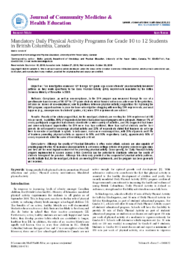
Mandatory Daily Physical Activity Programs for Grade 10 to 12 Students in British Columbia, Canada
Digital Document
| Content type |
Content type
|
|---|---|
| Collection(s) |
Collection(s)
|
| Resource Type |
Resource Type
|
| Genre |
Genre
|
| Peer Review Status |
Peer Review Status
Peer Reviewed
|
| Origin Information |
|
|---|
| Persons |
Author (aut): Landolfi, Emilio
|
|---|
| Abstract |
Abstract
Objective: This investigation examined 10th through 12th grade high school students’ physical activity behaviour
patterns as they relate specifically to the Daily Physical Activity (DPA) requirements mandated by the British
Columbia Ministry of Education in 2008.
Methods: Compliance, as well as non-compliance, to the DPA program was measured through the use of a
questionnaire-based survey of 86 10th to 12th grade students which focused not only on adherence to the guidelines,
but also on: issues of non-compliance; how to positively influence physical activity; suggestions for improving the
DPA program; support systems in place for those who might be struggling with meeting DPA requirements; and what
happens (e.g., consequences to students' grades, etc.) when DPA requirements are not met.
Results: Results of the study suggest that, for the most part, students are meeting the DPA requirement of 150
min per week. In addition, 89% of respondents believed that school-based programs were adequate. However 7% of
survey participants suggested that schools should offer a wider variety of activities, and 3% suggested that home
and community-based opportunities for DPA were less than sufficient. More than half of students confirm their
parents do not support or encourage physical activity, and 25% of respondents stated that teachers do not urge
them to exercise or participate in sports. In both cases, males were encouraged less, with 29% of parents and 71%
of teachers promoting physical activity as opposed to 55% and 80% respectively. Lastly, approximately 80% of
survey respondents noted the value of exercising with a friend.
Conclusions: Although the quality of Physical Education is often under attack, schools are also capable of
providing opportunities for increased physical activity in numerous settings outside of regularly scheduled gym class
and they are the most logical environment for promoting physical activity. Consequently, the Daily Physical Activity
program implemented in schools across British Columbia has the potential to drastically influence the health of
students throughout the province. Although this study only provided a tiny snapshot of physical activity patterns,
results indicate that, for the most part, students are meeting DPA requirements, and the program has been generally
well received. |
|---|---|
| Language |
Language
|
| Publication Title |
Publication Title
|
|---|---|
| Publication Number |
Publication Number
Volume 08, Issue 05
|
| Publication Identifier |
Publication Identifier
issn: 21610711
|
| Physical Description Note |
Physical Description Note
PUBLISHED
|
|---|
| DOI |
DOI
https://doi.org/10.4172/2161-0711.1000632
|
|---|
| Use and Reproduction |
Use and Reproduction
author
|
|---|
ufv_19680.pdf304.84 KB
Cite this
| Language |
English
|
|---|---|
| Name |
Mandatory Daily Physical Activity Programs for Grade 10 to 12 Students in British Columbia, Canada
|
| Authored on |
|
| MIME type |
application/pdf
|
| File size |
312159
|
| Media Use |